 |
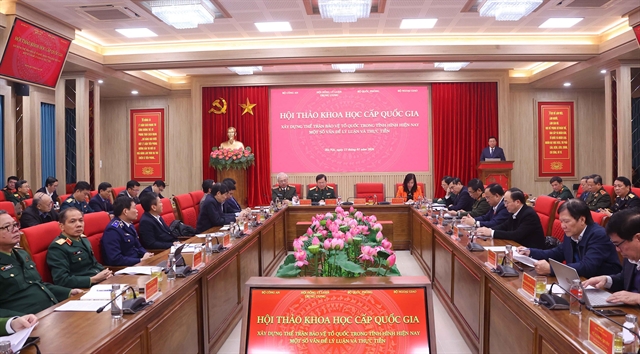
| An overview of the national-level scientific workshop themed "Building the posture to protect the Fatherland in the current situation – Theoretical and practical issues". — VNA/VNS Photo Văn Điệp |
HÀ NỘI — The Party has consistently upheld the view that safeguarding the Fatherland is a strategic, vital and enduring task of the Vietnamese revolution, senior military leaders and scholars heard at a national scientific workshop in Hà Nội on Tuesday.
Senior Lieutenant General Lê Huy Vịnh, a member of the Party Central Committee, the Central Military Commission and Deputy Minister of National Defence, underlined the stance at the workshop titled "Building the posture to protect the Fatherland in the current situation – theoretical and practical issues".
The event was organised by the Central Theory Council in coordination with the Ministry of National Defence, the Ministry of Public Security and the Ministry of Foreign Affairs.
Addressing the meeting, Vịnh said the Party’s approach drew on the long-standing tradition and experience of combining nation-building with defence throughout thousands of years of national history, grounded in Marxism-Leninism and Hồ Chí Minh Thought.
To firmly safeguard the Fatherland, it is essential to implement synchronised and comprehensive measures based on the combined strength of the entire political system and the whole nation, according to Vịnh.
On that basis, the Party has gradually developed and refined its theoretical thinking on the posture to protect the Fatherland, ensuring it responds in a timely way to practical requirements and tasks in each period.
In his keynote address, Professor Nguyễn Xuân Thắng, a Politburo member, Director of the Hồ Chí Minh National Academy of Politics and Chairman of the Central Theory Council, stressed that protecting the Fatherland should not confined to wartime or armed conflict but must be proactively and comprehensively prepared and carried out early, from afar and from the grassroots, even in peacetime.
This, he said, would require strategic proactivity in thinking on national protection to avoid passivity and surprise.
The scope of protection must be expanded from traditional territory to non-traditional spaces and from countering external threats to proactively identifying, preventing and addressing internal risks, especially those directly affecting the political and spiritual foundations of society.
According to Thắng, current realities point to two main groups of risks and challenges: external threats to sovereignty, unity and territorial integrity and internal risks to political and social stability and sustainable development. These risks do not exist in isolation but interact, overlap and can transform into one another.
“Therefore, protecting the Fatherland in the current situation cannot separate the defence of territorial sovereignty from maintaining political and social stability, ensuring sustainable development and consolidating the people’s posture. This requires a comprehensive, systematic and flexible approach, closely combining prevention and response, protection and development, external strength and endogenous strength,” Thắng said.
The all-people national defence posture is the firm pillar safeguarding independence, sovereignty, unity and territorial integrity, while the people’s security posture underpins political security, social order and safety and sustainable national development, according to Thắng. Though distinct in function, the two are closely linked and mutually reinforcing within a unified whole.
More than 40 years of renovation have shown that building and effectively mobilising the posture to protect the Fatherland has helped safeguard independence, sovereignty, unity and territorial integrity, maintain political and social stability, create a peaceful and favourable environment for socio-economic development and enhance Việt Nam’s position and prestige internationally.
However, amid rapid, complex and unpredictable global and regional changes and increasingly intertwined traditional and non-traditional security risks, particularly in emerging areas such as cyberspace, the economy, culture, ideology and society, building this posture presents new issues that require further study from multiple perspectives.
Reflecting its significance and timeliness, the workshop drew strong interest from leaders, managers, research bodies, scholars and practitioners from ministries, sectors, academies and localities nationwide.
Presentations and discussions at the event examined key issues across three areas: the theoretical basis, content, structure and operational logic of the posture to protect the Fatherland in the current context; practical experience in building this posture across sectors and spaces, both traditional and non-traditional; and the new context, requirements, orientations and solutions needed to strengthen and effectively apply it in the next stage of development.
The exchanges helped clarify a range of important theoretical and practical questions, notably the need to shift thinking from a defence-centred approach to a comprehensive, proactive and integrated one that closely links safeguarding the Fatherland with socio-economic development amid deepening international integration. — VNS