On the afternoon of September 27, the General Secretary and President, together with the Hanoi National Assembly delegation (representing Electoral Unit No. 1), met with voters from the wards of O Cho Dua, Ba Dinh, Ngoc Ha, Giang Vo, Hoan Kiem, Dong Da, Kim Lien, Lang, Cua Nam, and Van Mieu - Quoc Tu Giam ahead of the second session of the 16th National Assembly.
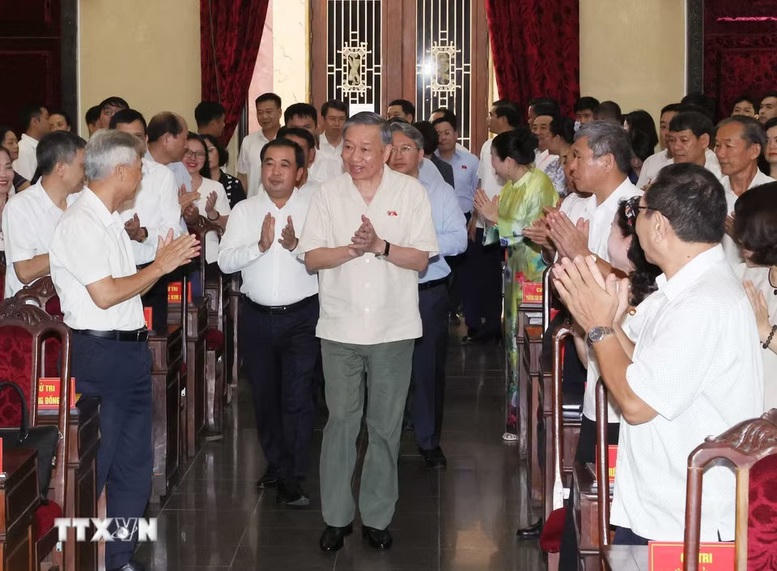
Also in attendance were Mr. Tran Duc Thang—Politburo member, Secretary of the Hanoi Party Committee, and Head of the Hanoi National Assembly Delegation—along with members of the Party Central Committee, representatives from central agencies and Hanoi municipal leadership, representatives from city departments and sectors, and constituents from ten wards.
Proposals rooted in grassroots realities
At the meeting, the Hanoi National Assembly Delegation briefed constituents on the expected agenda and content of the upcoming second session. They also presented responses from central and municipal authorities regarding proposals raised by constituents during the post-session meetings following the first session of the 16th National Assembly.
Seven constituents spoke directly at the meeting, offering diverse, specific, candid, and responsible feedback. Their proposals focused on key areas affecting citizens' daily lives and broader national development, including the organizational structure and operations of local government at two levels, education, healthcare, housing, land management, the environment, urban management, and mass mobilization work.
With a keen interest in the institutional refinement required to achieve socio-economic development goals—including modern infrastructure, urban development, digital transformation, scientific and technological advancement, social welfare, and improved living standards—voters have urged the National Assembly to continue reviewing and perfecting legal regulations regarding land, planning, public transport investment, and urban development. They seek a legal framework that enables localities to implement projects swiftly while ensuring synchronization, transparency, and efficiency.
Voters also proposed the gradual establishment of a unified electronic health record for every citizen, linking primary healthcare facilities with hospitals. They emphasized the need to prioritize service accessibility for the elderly, persons with disabilities, the disadvantaged, and population groups with limited means to proactively manage their health, while also calling for strengthened oversight regarding the availability of medicines, medical supplies, and equipment at public healthcare facilities.
Voters proposed continuing to review and rationally allocate the teaching workforce and ensuring a sufficient supply of textbooks so students can study with peace of mind. They also called for appropriate, scientifically designed timetables that enable students to participate in cultural, sports, artistic, and life-skills activities—thereby fostering comprehensive development in terms of knowledge, physique, and spirit—and urged improvements in the quality of school meals.
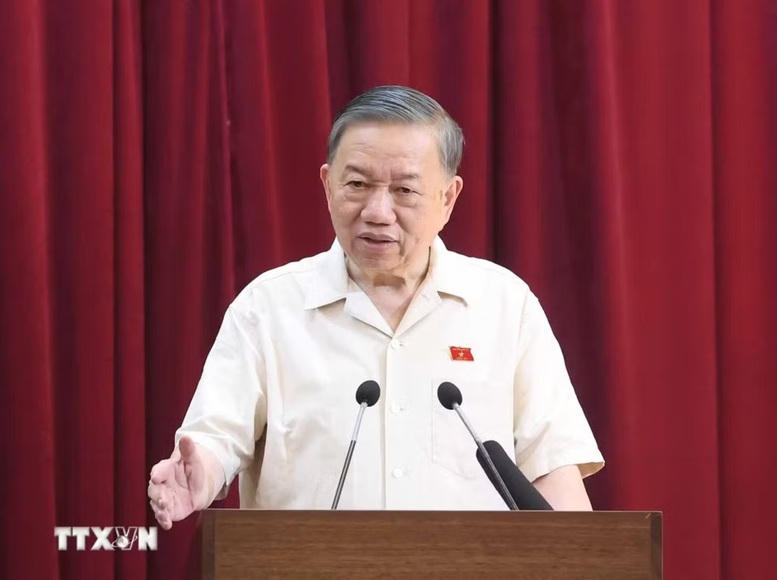
Speaking at the conference on behalf of the Hanoi National Assembly Delegation, General Secretary and President To Lam expressed sincere gratitude and fully acknowledged the voters' earnest and responsible feedback.
Briefing voters on key aspects of the national situation, General Secretary and President To Lam emphasized the special significance of 2026. It marks the first year of implementing the Resolution of the 14th National Party Congress and the start of the tenures for the 16th National Assembly and the state apparatus for the 2026–2031 term. The overarching spirit shared by the Party Central Committee, the National Assembly, the Government, and the entire political system is to avoid wasting time and to eliminate any lag between resolutions and actions, or between policy decisions and tangible real-world results.
The 16th National Assembly has already handled a massive workload during its two recent sessions. Looking ahead to the upcoming second session—which involves a heavy agenda—the guiding principle remains a crucial shift in mindset: laws should not merely serve management purposes but must actively foster development. Outdated regulations must not be allowed to become barriers; bottlenecks must be promptly removed to unlock and unleash resources for growth, all while safeguarding the legitimate rights and interests of the people. Reflecting on results achieved so far this year—amid a global landscape characterized by rapid and complex developments—we can be pleased to see that the country has maintained stability and sustained its growth momentum. Recent diplomatic activities demonstrate that international partners highly value Vietnam’s spirit of strategic autonomy and its role in addressing various international issues.
General Secretary and President To Lam emphasized that there is absolutely no room for complacency; ultimately, development must be measured by the quality of the people's lives. While high growth is essential, it must translate into better jobs, higher incomes, superior schools and hospitals, more suitable housing, a cleaner environment, and a public administration system that serves the people more effectively. If economic growth occurs without timely resolution of the people's legitimate daily concerns, the development outcomes cannot be considered complete.
Highlighting Hanoi’s strong transformation within the broader national context, General Secretary and President To Lam urged the capital to take the lead, set an example, and establish new benchmarks for urban governance, science and technology, digital transformation, green development, culture, public service quality, and overall quality of life.
These are demanding requirements that call for determination and decisive action across the entire political system, as well as the support, cooperation, and unity of Hanoi’s citizens and voters.
Turning major policies into concrete results
Addressing voter proposals regarding urban planning, land policy, and the implementation of major schemes and projects in Hanoi, General Secretary and President To Lam noted that the capital stands at a pivotal stage of development.
A comprehensive master plan with a long-term vision has already been established. The city is concretizing plans for specific areas and implementing major projects capable of transforming the Capital's landscape for decades to come.
While the majority of the public supports and welcomes these major development directions, there remain concerns and differing opinions regarding certain specific proposals.
City leaders must demonstrate a truly receptive attitude, remaining open to dialogue and listening; they must fully disclose information and seriously consider valid feedback from the public, experts, and scientists. The greater the scale and long-term impact of a project, the more thorough, scientific, and cautious the approach must be; quality and social consensus must not be sacrificed for the sake of speed.
General Secretary and President To Lam expressed his hope that voters and the public would continue to offer constructive contributions. Hanoi must become more modern without losing its soul; it must develop vigorously while preserving the historical, cultural, and landscape values that define the Capital's unique identity.
Innovation does not mean renewing everything, nor does preservation mean keeping everything exactly as it is. The goal is for the new to enrich the old, and for modernity to build upon tradition.
General Secretary and President To Lam emphasized that urban planning must be closely linked to land management and the implementation of major projects. There must be a determination to fundamentally address shortcomings and limitations, thereby transforming land into a resource for national development, while simultaneously ensuring full regard for the legitimate rights of the people.
Processes regarding land acquisition, compensation, support, and resettlement must be open, transparent, and balanced in terms of interests. Ultimately, the development of a city is intended, first and foremost, to improve the lives of the people who inhabit it. A sound policy must make the project implementation process fairer and reduce protracted complaints arising from...
Decentralization must be accompanied by the necessary personnel, resources, data, and accountability; tasks that can be handled at the local level should remain there rather than being pushed upward or forcing citizens to travel to multiple locations.
Public outreach and engagement efforts must also align with this principle. The most effective approach is to stay close to the people, understand their needs, and satisfactorily resolve their legitimate concerns. The ultimate yardstick for evaluating local-level administration is whether citizens face less travel, experience faster processing times, and see their petitions addressed clearly and promptly.
Regarding proposals concerning education and healthcare—issues that directly impact every family—General Secretary and President To Lam noted that the Secretariat has established a supervisory team to comprehensively assess the K-12 education system and formulate specific solutions.
Even a seemingly minor issue like a shortage of textbooks—while subsequently addressed—offers valuable lessons regarding the implementation responsibilities of competent authorities. A task is truly complete only when citizens receive the actual outcome, not merely when the management agency has finished its procedural steps.
General Secretary and President To Lam emphasized that grassroots healthcare facilities must genuinely serve as the primary point of care for the public. Training must be aligned with actual workforce needs, mechanisms must be established to deploy qualified professionals to local facilities, and lower-level and higher-level health systems must be interconnected through technology and data.
Regarding social housing and resettlement housing, the goal is not simply to provide a dwelling; these must be places where residents can live stable, convenient lives, with access to essential amenities in the surrounding area. Regarding issues concerning living environments and public safety, General Secretary and President To Lam emphasized that these are not trivial matters, nor are they the sole responsibility of a single sector; rather, the entire political system and every citizen must join hands to address them.
Hanoi must shift decisively from reactive, incident-based handling to routine, proactive governance, and from periodic "campaigns" to prevention and control at the source. Management must be driven by data, monitoring, and information transparency, with clear identification of pollution sources and responsibilities for remediation. Specifically, addressing air pollution requires a regional approach and coordination with neighboring localities, as pollution respects no administrative boundaries.
Regarding food safety, control must be exercised across the entire supply chain—from production, processing, and transportation to distribution. Traceability must be enhanced, and strict penalties imposed on counterfeit or unsafe food and acts that endanger public health. There must be no regulatory gaps or loopholes at any stage, from licensing, testing, and advertising to distribution and product traceability.
The Politburo has adopted a policy to unify state management of food safety from the central to local levels; Hanoi is urged to proactively prepare implementation plans, with a focus on clearly defining agency responsibilities and achieving a breakthrough transformation in the near future.
General Secretary and President To Lam noted that the National Assembly has recently focused heavily on paving the way through institutional reform. The upcoming session must maintain this momentum while paying greater attention to the practical outcomes of these institutional changes: are enacted laws truly taking effect in real life? Is decentralization accompanied by adequate resources? Are administrative procedures genuinely being reduced? ...whether the unlocked resources have truly translated into projects, products, jobs, income, and a better quality of life for the people.
For Hanoi, residents must be able to perceive this transformation through tangible improvements: less traffic congestion, streets that no longer flood after rain, cleaner neighborhoods, safer food, faster administrative processing, more convenient medical care, better-preserved heritage sites, and clearer responses to their petitions.
General Secretary and President To Lam expresses his confidence that, drawing upon its thousand-year cultural heritage, its stature, its resources, and—above all—the intellect, mettle, and aspirations of the Capital’s Party organization, authorities, and people, Hanoi will continue to innovate vigorously and execute tasks decisively. By turning major policies into concrete results, the Capital will achieve not only rapid growth but also high-quality, distinctive development, becoming an increasingly livable city.