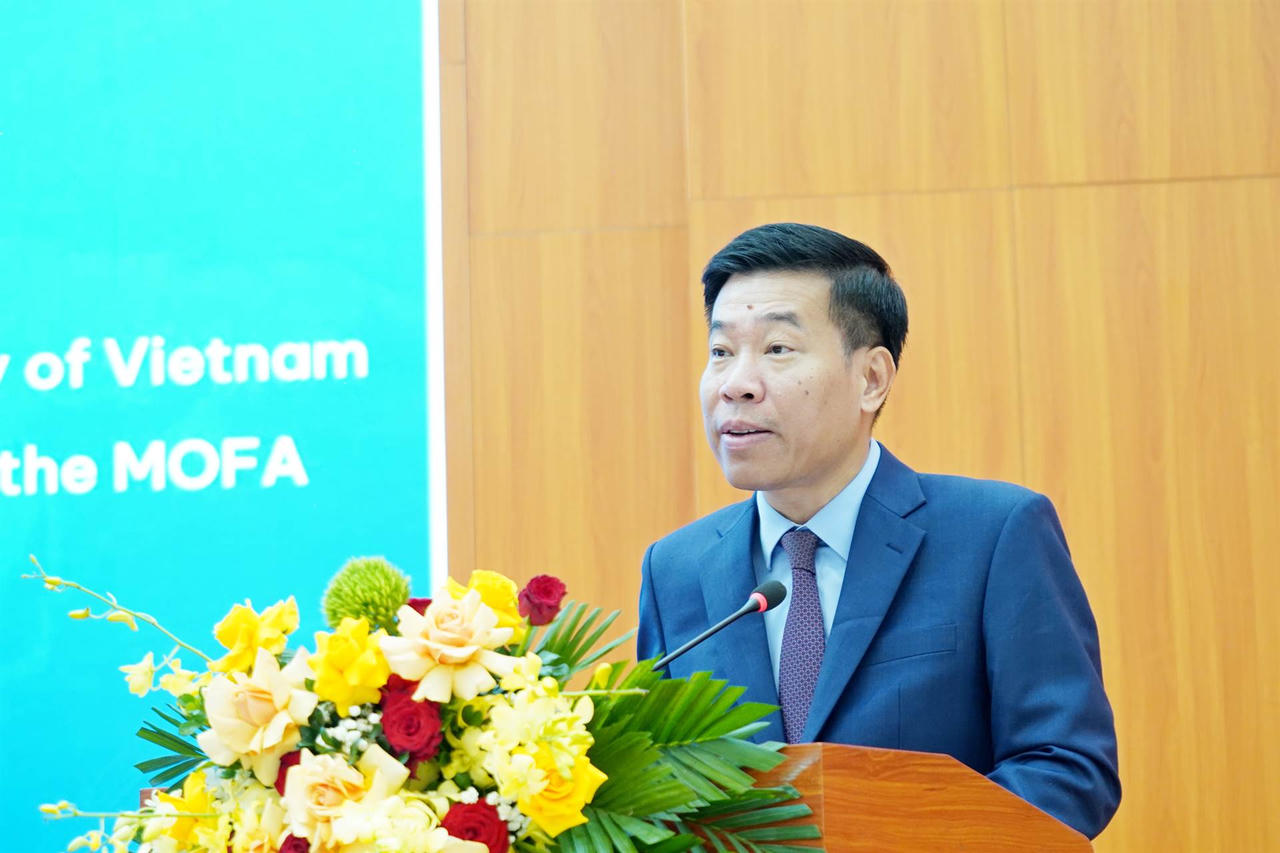
As part of the activities marking the 10th anniversary of the Vietnam-India Comprehensive Strategic Partnership (2016–2026), on August 27, Mr. Nguyen Manh Cuong—Member of the Party Central Committee, Permanent Deputy Secretary of the Ministry’s Party Committee, and Deputy Minister of Foreign Affairs—attended and delivered a speech at the seminar titled "Strengthening the Vietnam-India Comprehensive Strategic Partnership: Towards New Drivers of Development."Speaking at the seminar, Deputy Minister of Foreign Affairs Nguyen Manh Cuong emphasized that the world is undergoing profound and unpredictable changes, marked by intensifying strategic competition, the fragmentation of economies, technologies, and supply chains, and the intertwining of traditional and non-traditional security challenges. These dynamics require each nation to uphold its independence and autonomy while strengthening its resilience; at the same time, they must proactively integrate, diversify relations, and cooperate with trusted partners. This context underscores the growing strategic significance of the Vietnam-India relationship.
Against this backdrop, the elevation of Vietnam-India ties to a "Comprehensive Strategic Partnership"—formalized during the State visit to India by General Secretary and President To Lam—has ushered in a new phase of development defined by the spirit of "shared vision, strategic convergence, and substantive cooperation."
According to the Deputy Minister, Vietnam and India share a common aspiration to build prosperous, independent, autonomous, and self-reliant nations, as well as a vision for a peaceful, equitable international order grounded in international law.
Consequently, to implement the directives set by high-level leadership, the two countries need to achieve three key "transformations": translating political trust into a capacity for joint action; converting high-level commitments into specific, effective, and measurable programs and projects; and strengthening connectivity between Southeast Asia and South Asia, as well as between the Pacific and Indian Oceans.
Building on this foundation, the two nations must vigorously promote economic and technological cooperation. Priorities include the early conclusion of the AITIGA review, the expansion of market access and two-way investment—aiming for a trade turnover of $25 billion by 2030—and a gradual shift from mere goods exchange toward joint research, production, and the development of technology ecosystems in emerging sectors. Emphasizing the guiding principle that "political trust is the foundation, practical benefits are the driving force, the people are at the center, and concrete results are the yardstick," the Deputy Minister stated that future efforts should focus on flagship projects to create a distinct transformation in bilateral relations by 2030.
Also at the seminar, Minister of State Pabitra Margherita highlighted that Vietnam was the first country in Southeast Asia with which India established an Enhanced Comprehensive Strategic Partnership. He noted that the convergence of India’s "Viksit Bharat 2047" vision and Vietnam’s goal of becoming a developed nation by 2045—underpinned by long-standing cultural and civilizational ties—would provide the momentum for both countries to further advance their bilateral relationship in a robust and substantive manner.
The Minister of State shared that India’s leadership and people highly valued the recent State visit by General Secretary and President To Lam, emphasizing that the visit's outcomes have generated significant new momentum for bilateral ties.
He affirmed India's readiness to share experience, technology, and expertise with Vietnam in areas of mutual strength—particularly in science and technology, critical mineral supply chains, digital connectivity and payment systems, defense and security, and human resource development—with the aim of jointly building resilient supply chains and strengthening sustainable economic corridors between South Asia and Southeast Asia.
The seminar also featured in-depth discussions on specific, high-potential areas of cooperation between Vietnam and India, such as the economy, science and technology, youth engagement, education, and the enhancement of cultural connectivity in the time ahead.